Confident Grey

Here's how to fix the world through discourse. Strive to be confidently confused. This may sound paradoxical. Here's why it isn't.
When you have an opinion, it can be understood as existing on two spectra. The first of these two is your disposition, positive or negative, with regard to the idea, person, etc. in question. Let’s call this the 'disposition spectrum'. It’s the one people concern themselves with most of the time. When you say that you prefer dogs to cats, ice cream to cake, or strict gun control laws to lax ones, you are locating yourself somewhere on this disposition spectrum
The other spectrum is concerned with how confident you are with where you stand vis a vis the idea, person, etc. Lets call this the 'confidence spectrum' Where you exist on this one answers the question 'how sure are you of your opinion'.
I can hear you objecting that feeling either strongly positively or negatively with regard to something brings confidence along for the ride. I would agree that, in most cases, this is what people allow to happen. We are happy to consider how we feel about something, but reticent to follow up by investigating how sure we are that we should feel that way. So, we shut off the investigation after the initial answer and assume we have all that we need. But, this is done out of a desire for convenience and comfort rather than necessity. Consider whether you have ever felt attracted to something without being sure that you should feel that way. Or, whether you have ever felt concerned that your dislike for something or someone was entirely justified. Either case demonstrates the space between disposition and confidence.
Fixing the world through discourse, becoming a better leader, finding better solutions--they all rely on this in between space.
The Problem with Solutions
When people interact with one another around a central issue, their valence positions are almost certain to move centrifugally over time. Those on the extremes with regard to the issue exert a pulling force on those who are closer to their polarity. The reasons for this are manifold, but it is sufficient to point out that the more extreme the position the more vulnerable and, as a result, motivated the person holding it will be to defend it and convert others.
This often manifests as the extremist defending their position with greater ferocity, and being more willing to use shame and other such tactics in their conversion efforts.
This process is self-reinforcing. The successes those at the extremes experience pulling others toward their positions reinforce their already extreme opinions which, in turn, causes further radicalization. When I can get others to agree with me, I feel more invested in my position and further convinced that it must be correct. These effects are magnified by the presence of and interactions with those occupying to other half of the spectrum. Unless carefully structured and expertly managed, disagreements do not often lead to reconciliation. People who are disagreed with reliably dig in their heels, becoming more resistant to having their minds changed and more ready to accept whatever semblance of proof they can find to support their position. About the things we are predisposed to liking, we ask 'can I believe this'. About those we are predisposed to dislike we ask 'must I believe this'. People love nothing more than the feeling (for it is emotional feedback) of having their beliefs reflected back to them by the world, and few things less than the feeling of being wrong. Both of these can be explained simply if not comprehensively: it feels good to be right and bad to be wrong. People will do patently idiotic things to avoid confronting their prior errors. We would rather make mistakes than acknowledge them.
This understanding of group dynamics seems to suggest that interaction is doomed to create and reinforce tribes. Perhaps we had better avoid one another so that, at least, things won't get worse. Except that they will. The problems we face require collective solutions both with respect to formulation and implementation. Let alone making the needed changes, we can't even arrive at the best course of action without fully and honestly synthesizing the views of both sides.
In Other Words, We're Doomed…
So, how does one even share their views without polarizing the group? The only position where one can productively stand is the in between one--the gray one. Just as being for or against, positive or negative, exerts a force on the group, so does being undecided. The difference is that the force of the middle position can only pull. Because it recognizes the validity and in some way reflects all of the available positions, it can avoid repelling them despite the differences that exist. To the extent it is able to pull on those at the polarities, it is pulling them together rather than apart.
But, it is not sufficient to be gray. You must be confident in your grayness. If you are undecided and uncomfortable about it, you are looking for an excuse to be pulled to one side. Rather, you must be sure that the right, best place to be on the issue is undecided. This is what creates the whirlpool that pulls either side to the center. It also happens to be the most defensible position a majority of the time.
So, if you want to make a difference with regard to the fraught issues that are dividing people and destroying our ability to work together toward shared prosperity, take an honest look at the issue and recognize that if you believe there is a clear cut answer, you aren’t considering every facet of the problem. Rather, your beliefs are more likely symptoms of your having personally identified with a solution. This is most likely counterproductive as it means any contra-indicating evidence will threaten your sense of who you are rather than just the viability of your favored solution. As the list of complex problems to which you believe your fix applies grows, so does the likelihood that you have been captured by an idea and are personally invested in promoting it. Carl Jung pointed out that, "People don't have ideas. Ideas have people." This is often why ideas get misapplied despite clear indications that they are unsuitable. It is how poor outcomes can lead to doubling down. The more damage your solution produces, the more committed to it you may become since this, at least, allows you to avoid the shame of acknowledging your mistake. How many of history’s great tragedies were the product of people devoting themselves to shiny ideas rather than to the murky process of problem solving?
It should also be pointed out that being devoted to an answer means being equally devoted to the question. Plain old wrong answers are often easier to detect and ultimately less damaging than are right answers to wrong questions. Being a confident gray means retaining a stance that allows you to question the question that everyone else if trying to answer.
Flip Your Confidence
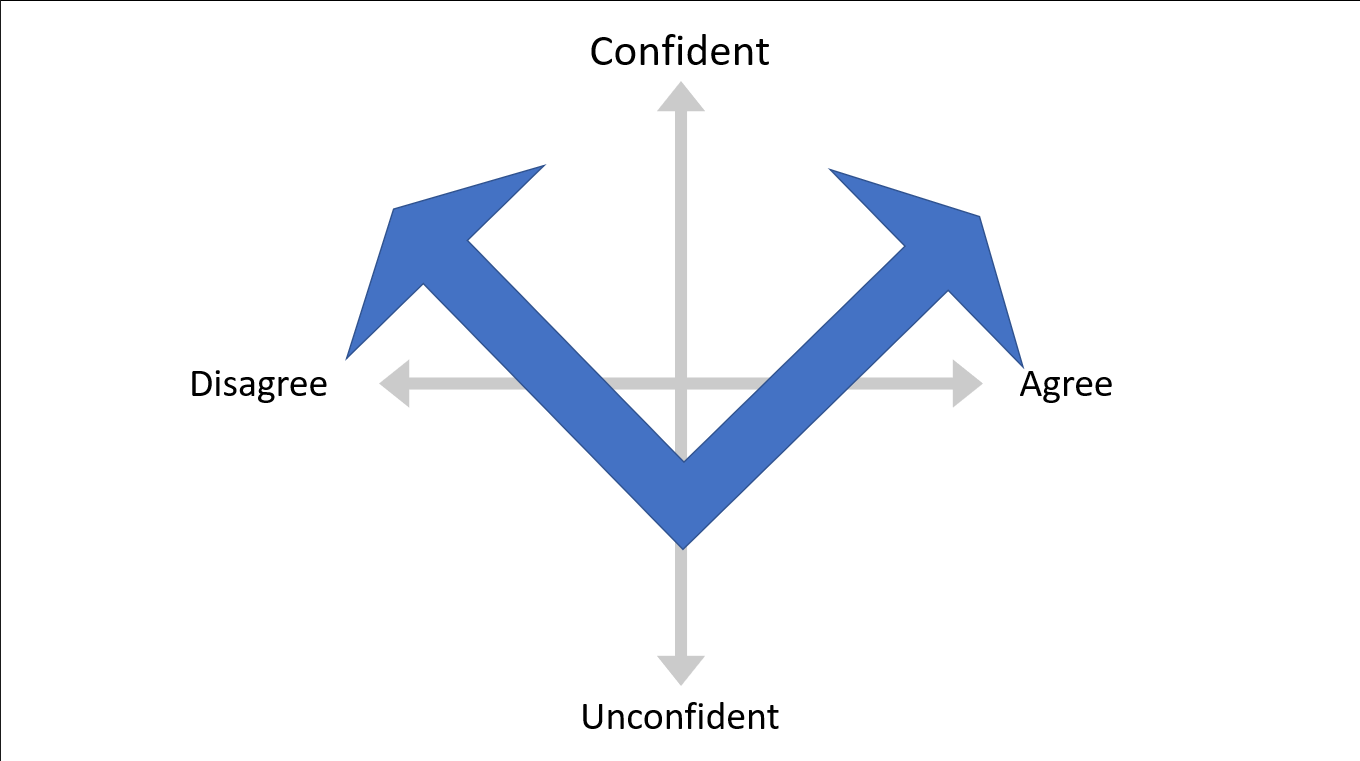
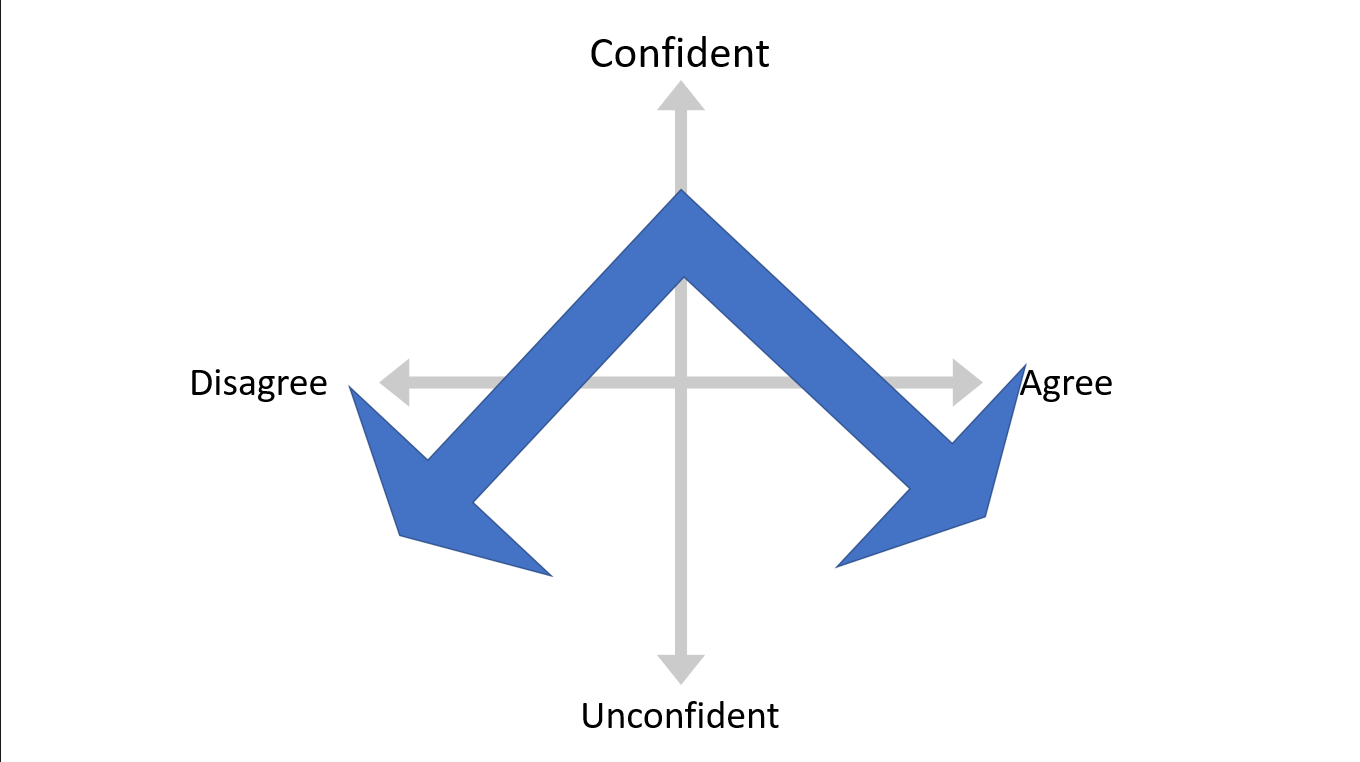
Consider how we habitually navigate the space of disposition and confidence. We follow the V-shaped line: as our disposition towards something becomes more polarized, we gain confidence in it. When we do not have a strong sense one way or the other, we feel as though we should. What I suggest is that we work to decouple disposition and confidence, manifesting instead something like the A-shaped line. As the valence of our position becomes more potent, we should look harder for disconfirming evidence and become less certain that our answer was the answer.
How do we accomplish this? Start with your behaviors. Take an issue about which you uncertain and say that it affords no easy answers. Then, choose something about which your mind is more or less made up and acknowledge the points from other side that resonate with you. Consider an issue that you have a strong sense about, then identify how it is more complex than you give it credit for being. And here's where you get to make a difference: do all of these in the presence of other people, holding with complete certainty the tension of the uncertain middle and communicating accordingly.
If your goal is real-world progress rather than social kudos and ego stroking, this is the way forward. It will draw people together and reflect the messiness of real-world problems, both of which are necessary if we are to arrive at real, working solutions.